How Operating Conditions Influence Oxygen Sensor Selection
Reliable oxygen measurement depends on more than the sensor’s measurement range or accuracy. In demanding industrial and OEM applications, temperature, pressure, humidity, contamination, corrosive gases, vibration and installation conditions can all influence measurement performance and sensor lifetime.
Selecting the right oxygen measurement technology therefore requires an understanding of the complete application environment. This article examines the main operating conditions that can affect oxygen measurement and explains how engineers can evaluate sensor technology, measurement approach, installation and maintenance requirements to achieve reliable long-term performance.
Table of contents
- What Makes an Oxygen Measurement Environment Harsh?
- How Operating Conditions Affect Oxygen Measurement
- Choosing the Right Measurement Approach
- From Operating Conditions to Measurement Requirements
- Maintenance, Calibration and Long-Term Reliability
- A Practical Oxygen Measurement Selection Checklist
- Conclusion
1. What Makes an Oxygen Measurement Environment Harsh?
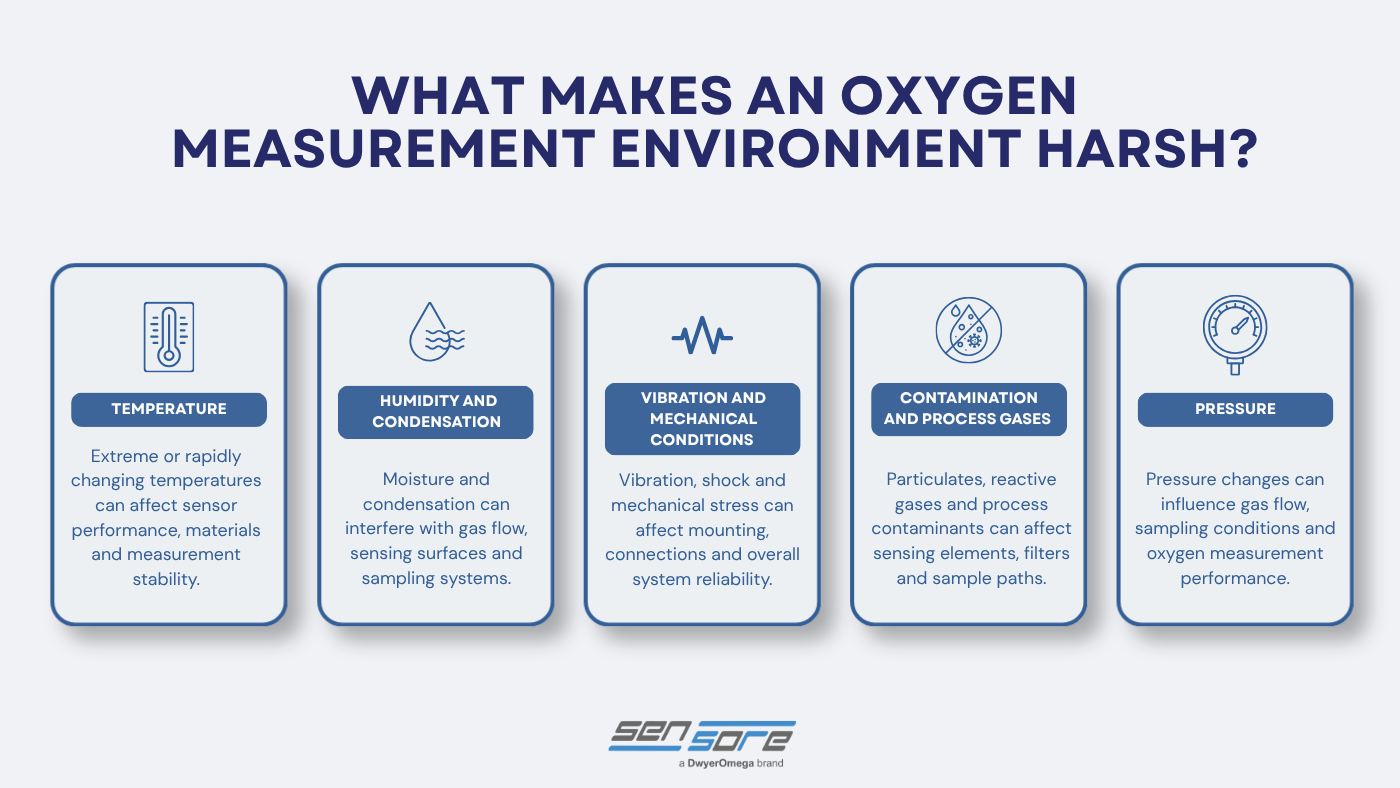
An oxygen sensor rarely operates under ideal laboratory conditions. In industrial and OEM applications, the measurement point may be exposed to temperature extremes, moisture, pressure variations, contaminants or mechanical stress.
These conditions can affect the sensing element directly, but they can also create problems elsewhere in the measurement system. Condensation may interfere with gas flow, particulates can block filters or diffusion paths, and corrosive gases may degrade materials over time.
Common factors that should be considered when evaluating an oxygen measurement system include:
- High or rapidly changing temperatures
- Pressure variations
- Humidity and condensation
- Dust and particulate contamination
- Corrosive or reactive gases
- Hydrocarbons and other process contaminants
- Vibration and mechanical shock
- Limited or hazardous maintenance access
The important point is that harsh conditions are application-specific. A temperature that is challenging for one oxygen sensor may be acceptable for another, while a gas contaminant that has little effect on one technology may significantly affect another.
For this reason, oxygen sensor selection should begin with the conditions at the measurement point rather than with the sensor datasheet alone.
2. How Operating Conditions Affect Oxygen Measurement
Temperature
Temperature is one of the first parameters engineers should consider when selecting an oxygen sensor.
High process temperatures can exceed the operating limits of the sensing element, housing, seals or electronics. Rapid temperature changes can also create thermal stress and affect measurement stability.
In some applications, a sensor designed to operate at elevated temperature can measure oxygen directly within a hot process stream. Zirconia oxygen sensors, for example, use a heated sensing element and are well established for applications where oxygen must be measured continuously under demanding thermal conditions.
In other applications, the sensor or analyser may need to remain at or near ambient temperature. This can influence the choice between different sensing technologies and may make an extractive measurement arrangement more practical.
Engineers should therefore consider both the normal operating temperature and temporary extremes, including startup, shutdown and process upsets.
Pressure
Pressure can influence oxygen measurement in different ways depending on the sensing technology and system architecture.
Changes in process pressure can affect gas flow, sampling conditions and the relationship between oxygen concentration and the measured signal. At lower pressures, compensation or controlled sample conditions may become particularly important.
For extractive systems, pressure regulation can also be required to ensure that the sample reaching the sensor is representative and stable.
The relevant question is therefore not simply:
“What is the operating pressure?”
but:
“What pressure will the oxygen sensor actually experience during measurement?”
Humidity and Condensation
Moisture is another common source of measurement problems.
High humidity may be acceptable for some sensors, but condensation is generally more problematic. Liquid water can interfere with gas diffusion, contaminate sensing surfaces or affect optical and electrical components.
In extractive systems, water can also condense inside sample tubing, filters or other components before the gas reaches the sensor. This can create measurement errors even when the analyzer itself is operating correctly.
Where condensation is possible, engineers should consider whether the system requires:
- Sample heating
- Cooling or controlled temperature
- Moisture removal
- Condensate management
- Appropriate sensor protection
Humidity should therefore be evaluated as part of the complete sampling and measurement system rather than as an isolated sensor specification.
Contamination and Process Gases
The composition of the gas being measured can be just as important as temperature and pressure.
Dust, soot, ash and other particulates can obstruct diffusion paths, filters or sample lines. Reactive gases may interact with sensing materials or other components and gradually affect measurement performance.
The potential presence of hydrocarbons, sulphur compounds, silanes, solvents or other aggressive gases should therefore be identified before selecting an oxygen measurement technology.
This is particularly important because contamination mechanisms differ between technologies. A contaminant that affects a zirconia oxygen sensor may not create the same problem for an optical system, while optical measurement systems can be particularly sensitive to contamination of optical surfaces.
There is therefore no universally “contamination-resistant” oxygen sensor. The correct approach is to identify which contaminants are present and how the selected technology responds to them.
Discover more: Zirconia Oxygen Sensors in Additive Manufacturing
Vibration and Mechanical Conditions
Mechanical conditions are sometimes overlooked during sensor selection.
Industrial equipment can expose sensors and sampling assemblies to continuous vibration, mechanical shock or thermal expansion. These conditions can affect mounting, connectors, seals, tubing and other components even when the sensing element itself remains within specification.
For OEM equipment, the sensor should therefore be evaluated as part of the complete mechanical assembly.
3. Choosing the Right Measurement Approach
Sensor technology is only one part of the oxygen measurement system. Engineers should also consider where the measurement takes place and how the gas reaches the sensor.
In-Situ Oxygen Measurement
In-situ systems measure oxygen directly at or within the process.
This approach can provide a short measurement path and fast access to changing oxygen conditions. It can be particularly useful when the sensor can tolerate the process environment and when rapid feedback is important.
However, direct exposure also means that the sensor must withstand the temperature, pressure, contaminants and mechanical conditions present at the measurement point.
In-situ measurement is therefore most suitable when the process environment is compatible with the selected oxygen sensor.
Extractive Oxygen Measurement
Extractive systems remove a sample from the process and transport it to an oxygen sensor or analyser.
One of the main advantages is that the sample can be conditioned before measurement. Depending on the application, this may involve filtration, cooling, drying, pressure regulation or flow control.
This can protect the measurement technology from particularly harsh process conditions.
The trade-off is increased system complexity. Sample lines, filters, pumps, valves and condensate management components introduce additional potential sources of measurement error and maintenance.
The choice between in-situ and extractive measurement should therefore be based on the relationship between the process environment and the sensor’s operating requirements.
4. From Operating Conditions to Measurement Requirements
Different oxygen measurement technologies respond differently to environmental conditions. Technology selection should therefore be based on the combination of requirements rather than on a single performance specification.
| Application factor | What engineers should evaluate |
|---|---|
| High temperature | Sensor and housing temperature limits |
| Low oxygen concentration | Required measurement range and accuracy |
| High humidity | Condensation and moisture management |
| Contaminated gas | Sensor compatibility and sample protection |
| Corrosive gases | Materials and sensing-element compatibility |
| Fast-changing process | Required response time |
| Difficult access | Service interval and replacement requirements |
| OEM integration | Size, power, outputs and system architecture |
Controlled-atmosphere applications can place particular emphasis on low oxygen measurement, long-term stability and reliable system integration. See how these requirements apply to oxygen measurement in gloveboxes and controlled environments.
Similar considerations apply to oxygen monitoring for welding, inerting and fire prevention, where maintaining the required atmosphere can be critical to process control and safety.
Other oxygen measurement technologies
Electrochemical, optical and other measurement technologies may offer advantages under different operating conditions. Factors such as operating temperature, response time, measurement range, maintenance requirements and environmental exposure should determine which approach is appropriate.
The objective should not be to select the most sophisticated technology available, but the technology that provides the best fit for the application’s actual requirements.
5. Maintenance, Calibration and Long-Term Reliability
A sensor that performs well when new is not necessarily the best choice for a demanding application. Long-term reliability also depends on maintenance requirements, accessibility and expected service life.
Before selecting an oxygen measurement system, engineers should consider:
- How frequently calibration or verification is required
- Expected sensor lifetime
- Ease of sensor replacement
- Accessibility of the installation point
- Filter and sample-line maintenance
- Availability of spare components
- Requirements for calibration gases
- Consequences of measurement downtime
A low-cost oxygen sensor may become expensive if it requires frequent replacement in a difficult-to-access location. Conversely, a more complex system may be justified when it significantly reduces maintenance or protects the measurement technology from a harsh process environment.
For OEM manufacturers, lifecycle considerations are particularly important because the selected sensor may remain in production for many years.
6. A Practical Oxygen Measurement Selection Checklist
Before selecting an oxygen sensor or oxygen measurement system, engineers should define the application using the following questions:
Measurement requirements
- What oxygen concentration range must be measured?
- How quickly must the system respond?
- Is the measurement used for monitoring, control, alarm or safety?
Operating conditions
- What are the normal and maximum temperatures?
- What pressure range will the sensor experience?
- Is humidity or condensation present?
- Are dust, particulates or process deposits expected?
- Are corrosive, reactive or combustible gases present?
- Is the equipment exposed to vibration or mechanical shock?
System architecture
- Should the measurement be in-situ or extractive?
- How will the oxygen measurement integrate with the control or monitoring system?
Lifecycle requirements
- How often can the system be serviced?
- What sensor lifetime is expected?
- How easily can the sensor be replaced?
- Is long-term component availability important?
Answering these questions before selecting the technology can prevent many of the integration and reliability problems that only become apparent after installation.
Conclusion
Selecting the right oxygen measurement technology for harsh operating conditions is ultimately an application engineering decision.
Temperature, pressure, humidity, contamination, gas composition, vibration, installation method and maintenance access can all influence the suitability of an oxygen sensor. The most appropriate solution is therefore not necessarily the technology with the highest specification, but the one that can reliably perform within the actual conditions of the application.
By evaluating the measurement environment first and then selecting the appropriate sensor technology and measurement architecture, engineers can improve measurement reliability, reduce unnecessary maintenance and support longer-term system performance.
Need Help Selecting an Oxygen Measurement Solution?
Every application has different operating conditions and integration requirements. Sensore can help you evaluate your oxygen measurement requirements and identify a suitable sensing approach for reliable long-term operation.